
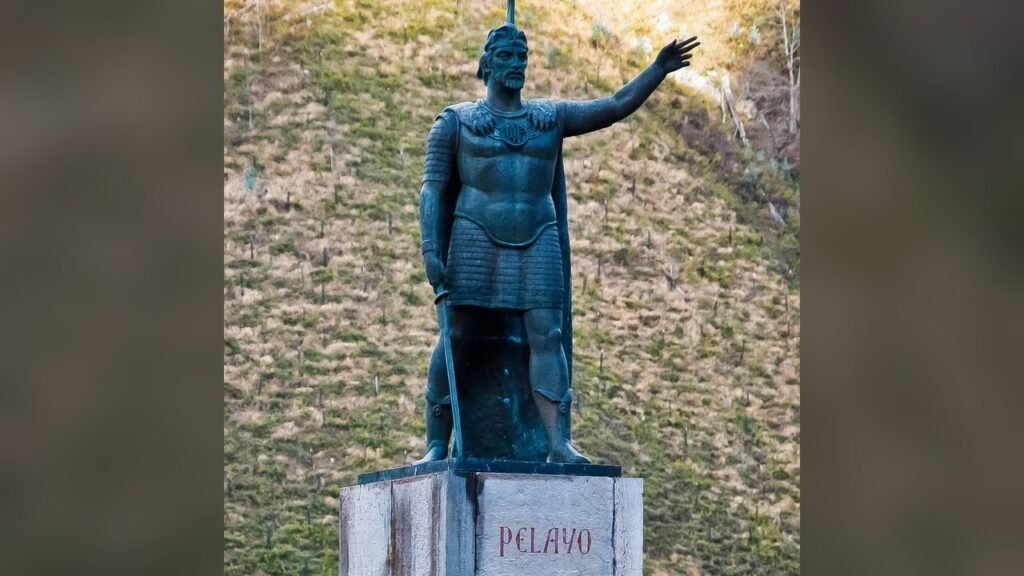
Prefer to watch? The full episode is on YouTube. Subscribe so you don’t miss the next one, and follow us on Facebook.
Short answer: Pelayo (Don Pelayo in Spanish) was the nobleman, a Goth according to the chronicles, who in the early 8th century led the revolt of the Astures against Muslim rule, won at Covadonga around 718 or 722, and is regarded as the first king of Asturias. He died at Cangas de Onís in 737. Almost everything we know about him comes from chronicles written at the court of Oviedo about a hundred and fifty years later, at the end of the 9th century, so the historical Pelayo and the legendary one are closely intertwined.
This article is a summary. Here we answer who Pelayo was. The battle, the miracle and how that story came to be written are covered in the documentary above and in the episode article: Covadonga: the miracle that was written 150 years later.
What the 9th-century chronicles say
The Christian sources on Pelayo are three texts written at the court of King Alfonso III in Oviedo around 880–890: the Chronicle of Albelda and the two versions of the Chronicle of Alfonso III, the Rotensis and the Ad Sebastianum. The Christian source closest to the events, the Mozarabic Chronicle of 754, written in Muslim territory, never mentions Pelayo.
The three chronicles do not agree about his origins. The Rotensis presents him as a spatharius of kings Witiza and Roderic, that is, a member of the guard or military circle of the court of Toledo. The Ad Sebastianum, a version revised in style and ideas, makes him the son of Duke Fafila and of royal lineage. The Albeldensis says Witiza had banished him from Toledo, which is why he came to Asturias. All three agree on the essentials: a man linked to the Gothic court who ended up in the northern mountains.
The chronicles also explain why he rebelled. According to the Chronicle of Alfonso III, Munuza, the Muslim governor of Gijón, wanted Pelayo’s sister and, to get him out of the way, sent him to Córdoba on an errand. On his return Pelayo refused to accept the union and fled towards the mountains. The chronicle does not give the sister’s name, and historians debate whether the episode is history or a legend embellished over time.
There are also Arabic sources, much later, that preserve older traditions. Al-Maqqari, in the 17th century, speaks of a certain Belay who took refuge in the mountains with a handful of men, and other traditions place him in Córdoba as a hostage before he escaped north. That an enemy like him also appears in the other side’s sources is one of the best arguments that Pelayo existed.
Goth, Astur, or both? The debate over his origins
The chronicles had a clear agenda: the 9th-century kings of Asturias wanted to present themselves as the rightful heirs of the Visigothic kingdom of Toledo. Historians call this idea neo-Gothicism, and it means that everything that makes Pelayo a great Gothic noble must be read with caution.
On that basis, modern debate has gone in several directions. Claudio Sánchez-Albornoz saw him as a dignitary of the Gothic court who put himself at the head of a rebellion of the Astures. Abilio Barbero and Marcelo Vigil, in the 1970s, stressed the opposite: that the movement was rooted in the little-Romanised native societies of the north, which had already resisted the Visigoths. Armando Besga Marroquín, by contrast, argued for the weight of Hispano-Gothic elements in the origins of the kingdom. Today many specialists accept a mixture: a leader linked to the Gothic world, heading a local society with its own reasons to rebel. His exact origin remains an open question.
Was he a king, or a leader later called king?
According to the Rotensis, when Pelayo fled to Mount Auseva the Astures met in assembly and chose him as princeps, prince or leader. He was not crowned in Toledo or anointed by bishops: he was acclaimed by his own people. The same chronicles, written when a settled kingdom already existed in Oviedo, later count him as the first king and credit him with a nineteen-year reign.
That is why many historians prefer to speak of a lordship centred on Cangas de Onís rather than a kingdom with institutions. The royal title was given to him in the memory of his successors, who needed a founder. It is not a complete invention, but it is a 9th-century reading of 8th-century events.
Pelayo and Covadonga: what can be stated
The account of the battle is full of literary elements: the dialogue with Bishop Oppa at the mouth of the cave, the stones that turn back on those who throw them, the mountain that collapses on the fugitives, and impossible figures of tens of thousands of dead. None of that can be taken literally.
What does seem reasonable to state is more modest: that there was a clash in the Auseva valley between Pelayo’s men and a force sent to subdue him, that Pelayo was not defeated, and that afterwards the Muslim governor of Gijón, Munuza, left the area. There is no agreement on the date: Sánchez-Albornoz argued for 722, and other scholars prefer 718. Covadonga was not the great battle tradition imagined, but it was the starting point of an independent Christian power in the mountains. We cover the battle itself — the Christian and Arabic sources, the date and the miracle — in detail in our article on the Battle of Covadonga.
What happened after his death
The chronicles say Pelayo died a natural death in 737, at Cangas de Onís. The report that he was buried with his wife, Queen Gaudiosa, in the church of Santa Eulalia de Abamia is a 12th-century addition attributed to Bishop Pelayo of Oviedo, although it reflects a deep-rooted local tradition. Another tradition says Alfonso X had his remains moved to the cave of Covadonga, where his tomb is shown today; historians doubt that transfer.
He was succeeded by his son Fafila, or Favila, who reigned for only two years: according to the chronicles, he was killed by a bear in 739. The throne then passed to Alfonso I, husband of Pelayo’s daughter Ermesinda and son of Duke Peter of Cantabria. Under him that small mountain nucleus began to spread along the Cantabrian coast and westwards, the road that centuries later would lead to the Kingdom of Galicia. Before the Astures, the north-west had already had its own kingdom after the fall of Rome: the Suebic kingdom.
Frequently asked questions about Pelayo
Did Pelayo really exist?
Most historians believe so. The Asturian chronicles are late, but Arabic sources also mention a rebel called Belay in the northern mountains. What is debated is his origin and many details of his life.
Was Pelayo a Visigoth?
The 9th-century chronicles make him a Gothic noble, but they had an interest in presenting the kings of Asturias as heirs of Toledo. He may have been, or not; what is certain is that he relied on the Astures.
Where is Pelayo buried?
A 12th-century note places him at Santa Eulalia de Abamia, in Cangas de Onís, beside his wife Gaudiosa. Another tradition speaks of a transfer to the cave of Covadonga, where his tomb is shown, but that transfer is doubtful.
When was the battle of Covadonga?
Around 718 or 722. The sources do not allow the date to be fixed with certainty, and historians remain divided.
📚 Recommended books
Further reading


As an Amazon Associate I earn from qualifying purchases.
More Historia española episodes
- Covadonga: the miracle that was written 150 years later
- A kingdom without a king: the story of the Kingdom of Galicia
- The forgotten kingdom that was born in Galicia after the fall of Rome
- All episodes
Prefer to watch? The full episode is on YouTube. Subscribe so you don’t miss the next one, and follow us on Facebook.
Main sources
- Crónicas asturianas (Albeldensis, Rotensis and Ad Sebastianum), ed. J. Gil Fernández, J. L. Moralejo and J. I. Ruiz de la Peña (University of Oviedo, 1985)
- Mozarabic Chronicle of 754
- Al-Maqqari, Nafh al-tib (17th century), drawing on earlier traditions
- C. Sánchez-Albornoz, Orígenes de la nación española. Estudios críticos sobre la historia del reino de Asturias (1972–1975)
- A. Barbero and M. Vigil, Sobre los orígenes sociales de la Reconquista (1974)
- A. Besga Marroquín, Orígenes hispanogodos del Reino de Asturias (RIDEA, 2000)
- Historia española documentary “Covadonga: la batalla que cambió la historia de España” (2026)
- Featured image: D.Rovchak, CC BY-SA 4.0, via Wikimedia Commons