
Prefer to watch? The full episode is on YouTube. Subscribe so you don’t miss the next one, and follow us on Facebook.
Short answer: Tartessos was in the south-west of the Iberian Peninsula. Greek and Latin sources place it around the lower Guadalquivir, the river that Strabo says was once called Tartessos, and archaeology documents its culture, roughly between the 8th and 5th centuries BC, in today’s provinces of Huelva, Seville and Cádiz, extending into the middle Guadiana valley in Badajoz and southern Portugal. What nobody has found is a capital: no excavation has securely identified a city that is “the” Tartessos of the texts.
This article is a summary. It only answers the question of where it was. If you want to know whether it really existed, what has been excavated and how it ended, watch the documentary above or read the episode article: Did Tartessos really exist? What archaeology reveals.
What the Greek and Latin sources say
Ancient texts speak of Tartessos as a very distant and very rich place at the western edge of the known world. Herodotus, in the 5th century BC, tells how a ship from Samos under Kolaios was blown there by the wind, beyond the Pillars of Hercules, and came back with huge profits. He also mentions a king of Tartessos, Arganthonios, a friend of the Phocaeans. But he gives no point on the map.
The geographical clues come later. Strabo, in the age of Augustus, writes that the ancients seem to have called the river Baetis, the Guadalquivir, Tartessos; that, because the river had two mouths, a city of the same name was said to have stood between them; and that the region was called Tartessis. Pausanias repeats the image of the two-mouthed river and records that some identified Tartessos with Carteia, on the Bay of Algeciras. And Avienus, in his 4th-century AD poem Ora maritima, writes that Gadir, today’s Cádiz, was formerly called Tartessos.
A river, a city, a region and several candidates: the ancients themselves did not agree, and most were writing from hearsay, centuries later. That is why historians today distinguish between the Tartessos of the texts and the Tartessian culture that archaeologists excavate.
The south-west: Huelva, the Guadalquivir and Cádiz
Archaeology has not found a city with a sign on it, but it has found an area with a shared material culture. Its core is usually drawn as a triangle between Huelva, Seville and Cádiz, around the ancient mouth of the Guadalquivir. Huelva is a key piece: in 1923 a large hoard of bronze weapons came out of its estuary, and thousands of fragments of Phoenician, Greek and local pottery have been found under the city centre, which their excavators date to the 9th and 8th centuries BC (other researchers dispute those dates): the sign of a very early trading port. Close by are the copper and silver mines of the hills, such as Riotinto, the basis of that wealth.
On the lower Guadalquivir lies the sanctuary of El Carambolo, at Camas near Seville, where the famous gold treasure was found in 1958, along with other sites in the Seville countryside. On the coast, the Phoenicians founded Gadir, today’s Cádiz, which lived alongside and traded with the Tartessian communities. Inland, the same culture can be recognised in the middle Guadiana valley, in Badajoz, and in southern Portugal, where inscriptions in the so-called south-western script appear.
Was there a capital? What has not been located
This is the part that search results rarely tell you: we do not know whether Tartessos had a capital. Many have been proposed. Adolf Schulten looked for it under the sands of Doñana; other researchers have argued that Huelva was its main centre; others point to the Seville area or Carmona; and Avienus’s tradition points to Cádiz. None of these proposals has been proved.
Behind the question lies a deeper one: whether Tartessos was a unified kingdom, with a king like Arganthonios at its head, or a set of communities with a common culture to which the Greeks gave a single name. Specialists such as Sebastián Celestino and Carolina López-Ruiz debate how it was organised. Until a city turns up that fits the texts, the honest answer to “where was the city of Tartessos?” is that we do not know.
A changed landscape: Doñana and the old river mouth
Looking for Tartessos on today’s map has a catch: the coastline is not the same. Almost three thousand years ago the Guadalquivir did not end in the marshes we know, but in a wide estuary open to the sea, which Avienus calls the Ligustine lake. Over the centuries the river’s sediment filled it in until it became the Doñana marshes. Places that were then on the water are now inland.
That explains why Doñana drew so many seekers of the lost city. Between 1923 and 1925, Schulten and Jorge Bonsor dug in the Coto de Doñana, convinced that Tartessos lay there. They found Roman remains, not the Tartessian capital. Schulten even linked Tartessos with Plato’s Atlantis, an idea no excavation has confirmed. His book remains a classic for understanding the history of that search, even though its conclusions are outdated.
Sites you can actually visit (El Carambolo, Cancho Roano)
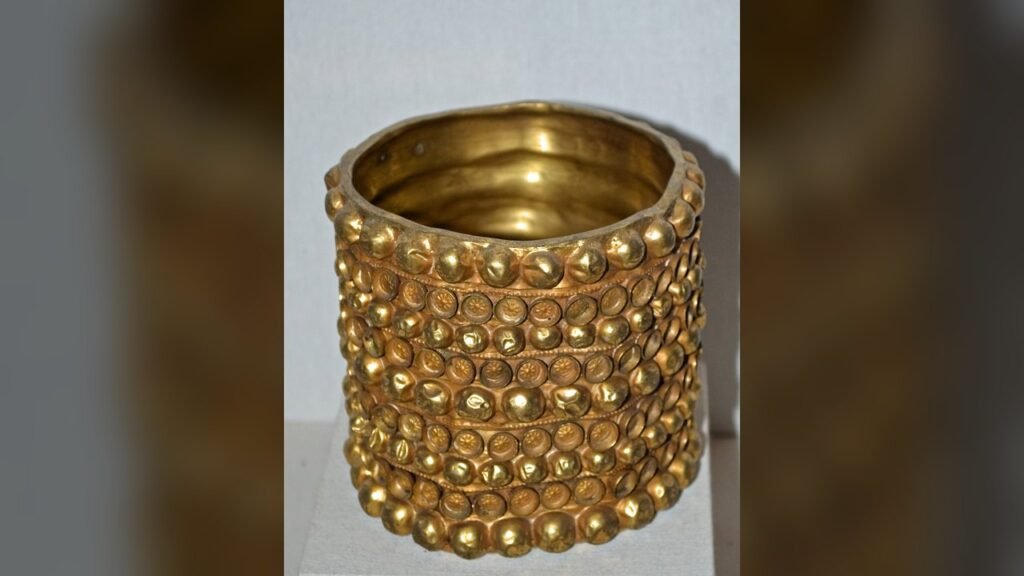
If you want to see Tartessos for yourself, these are the clearest stops. El Carambolo, at Camas (Seville), is where the treasure was found: 21 gold pieces weighing almost three kilos, now interpreted as belonging to a sanctuary of Phoenician influence. Before you go, check where and when the treasure or its replica is on display, because that has changed over the years.
Cancho Roano, near Zalamea de la Serena (Badajoz), is a large 5th-century BC building surrounded by a moat, interpreted as a palace-sanctuary, which its occupants deliberately burned and sealed. It can be visited and has an interpretation centre. In the same area is Casas del Turuñuelo, at Guareña, where reliefs with human faces were found in 2023; as an active excavation, visits depend on the digging seasons.
These places make the answer clear: Tartessos is not a dot on the map but a south-western region with its centre of gravity on the lower Guadalquivir and Huelva. For what came before all this, continue with When does the history of Spain begin?, and for what came after, with Rome’s arrival in Hispania.
Frequently asked questions about where Tartessos was
Where was the city of Tartessos?
Nobody knows. Strabo speaks of a city between the two mouths of the Guadalquivir, Pausanias mentions Carteia and Avienus identifies it with Cádiz, but no excavation has confirmed a specific city.
Was Tartessos in Huelva?
Huelva was one of its main centres, with an active port and mines nearby, but Tartessian culture covered a much wider area, including the lower Guadalquivir and reaching as far as the Guadiana.
Was Tartessos in Doñana?
Schulten believed so and dug there between 1923 and 1925 without finding it. In Tartessian times the area was an open estuary, so some remains may now lie under the marsh sediments, but there is no evidence of a capital in Doñana.
When did Tartessos exist?
Tartessian culture is dated roughly between the 8th and 5th centuries BC, built on older Late Bronze Age local communities and in close contact with Phoenicians and Greeks.
📚 Recommended books
Further reading
Tarteso: El enigma de la primera civilización de Occidente


As an Amazon Associate I earn from qualifying purchases.
More Historia española episodes
- Did Tartessos really exist? What archaeology reveals
- When does the history of Spain begin? Long before any king
- Rome didn’t come to conquer Hispania… and stayed for 600 years
- All episodes
Prefer to watch? The full episode is on YouTube. Subscribe so you don’t miss the next one, and follow us on Facebook.
Main sources
- Herodotus, Histories, I.163 and IV.152
- Strabo, Geography, III.2.11; Pausanias, Description of Greece, VI.19.3
- Avienus, Ora maritima (4th century AD)
- S. Celestino and C. López-Ruiz, Tarteso y los fenicios de Occidente (Almuzara, 2020); English ed. Tartessos and the Phoenicians in Iberia (Oxford, 2016)
- S. Celestino and E. Rodríguez González, Tarteso: El enigma de la primera civilización de Occidente (Pinolia, 2024)
- A. Schulten, Tartessos (1st German ed. 1922)
- Historia española documentary “¿Existió de verdad Tartessos? Lo que revela la arqueología” (2026)
- Featured image: Anual (photo of a replica), public domain, via Wikimedia Commons