
Prefer to watch? The full episode is on YouTube. Subscribe so you don’t miss the next one, and follow us on Facebook.
Short answer: Viriathus (Viriato in Spanish and Portuguese) was a Lusitanian leader who led the resistance against Rome in the west of the Iberian Peninsula between 147 and 139 BC. According to the ancient sources he had been a shepherd, and he was one of the few survivors of the massacre of Lusitanians ordered by the praetor Servius Sulpicius Galba in 150 BC. He defeated several Roman governors with a war of movement and ambushes, forced Rome to sign a treaty recognising him as a friend of the Roman people, and was murdered in his sleep by three of his own men, bribed by the consul Quintus Servilius Caepio.
This article is a summary. Viriathus appears in our documentary on the siege of Numantia (the video above), because his war is the generation before the city fell. For the full story, watch the documentary or read the episode article: Siege of Numantia: what happened in 133 BC, and what Appian says.
What the sources say about who Viriathus was
Viriathus left nothing in writing. Everything we know about him comes from Greek and Roman authors, that is, from the enemy side, written decades or centuries later. The main ones are Appian, who told the story of Rome’s wars in Hispania in his Iberiké in the 2nd century AD; Diodorus of Sicily, of the 1st century BC, whose book 33 survives only in fragments; and the summaries (Periochae) of Livy’s lost books. Later writers such as Florus, Eutropius and Orosius repeat and embellish that tradition.
Diodorus presents him as a shepherd used to mountain life from childhood, who became a hunter and then a fighter and band leader. He stresses his toughness, his frugality and his generosity in sharing out booty, and tells a story, of doubtful accuracy, about his wedding to the daughter of a rich man, Astolpas, at which Viriathus barely touched the feast. It is the portrait of the austere leader set against wealth, and it should be read for what it is: a moral model from Greek literature, not a first-hand report.
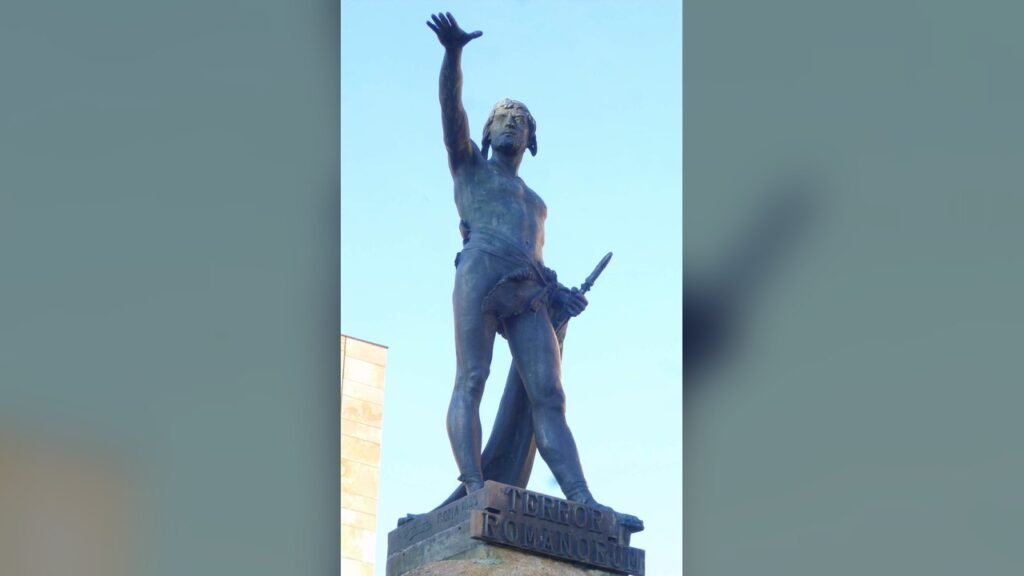
Nor do we know where he was born. He was Lusitanian, and Lusitania at the time covered, roughly, central Portugal and part of today’s Extremadura. That is why both Spain and Portugal have claimed him for centuries. Traditions that make him a native of a specific place, such as the Serra da Estrela or Zamora, where he has a famous monument, are not supported by any ancient source.
The Lusitanian wars: from Galba’s massacre to Viriathus’s leadership
From the middle of the 2nd century BC, the Lusitanians frequently raided the Roman province of Further Spain (Hispania Ulterior), in the Guadalquivir valley. In 150 BC the praetor Galba offered them land in exchange for peace. According to Appian, he divided them into three groups, asked them to hand over their weapons and, once they were disarmed, had them killed or sold into slavery. It was a scandal even in Rome: Cato the Elder spoke against Galba, who was nevertheless acquitted. Among the few who escaped, Appian says, was Viriathus.
Three years later, in 147 BC, a Lusitanian army was cornered by the praetor Gaius Vetilius and was about to accept a similar offer. Viriathus reminded them of Galba’s treachery and offered to get them out. He drew his men up as if for battle, suddenly scattered them in every direction and covered the retreat with about a thousand horsemen. They regrouped at a town Appian calls Tribola. Shortly afterwards he lured Vetilius into an ambush in which the praetor himself was killed. From then on, Viriathus was the leader.
How he stood up to Rome
Viriathus did not win through great pitched battles but through mobility: he knew the ground, struck and withdrew, staged retreats that ended in ambushes and avoided the clashes in which Roman infantry was stronger. In this way he defeated several governors, among them Gaius Plautius and Claudius Unimanus, and carried his raids as far as Carpetania, in the centre of the Meseta, and the Guadalquivir valley.
Rome had to send consuls. Quintus Fabius Maximus Aemilianus, brother of Scipio Aemilianus, had some success in 145–144 BC, but the war spread: Appian says Viriathus encouraged the Arevaci, Titthi and Belli, Celtiberian peoples, to rise up, which set off the Numantine war. In 140 BC the consul Quintus Fabius Maximus Servilianus was trapped with his army near a town called Erisana. Viriathus let him go in exchange for a treaty: the Lusitanians would keep their land and he would be recognised as a friend of the Roman people. According to Appian, the Roman people ratified it. Livy’s summary calls it a peace on equal terms that tarnished Fabius’s successes.
His death in 139 BC
The peace did not last. Quintus Servilius Caepio, Servilianus’s brother and the new governor of Further Spain, pressed the Senate to break the treaty and restarted the war. Viriathus sent three trusted men, Audax, Ditalcus and Minurus, to negotiate with him. Caepio bought them. When they returned, Appian says, they entered Viriathus’s tent while he slept and killed him with a wound to the throat.
The phrase “Rome does not pay traitors” is famous, but it does not appear in that form in Appian, who says Caepio let them keep what they had received and referred them to Rome for the rest. Eutropius, in the 4th century, records a similar answer: the Romans had never approved of a general being killed by his own soldiers. The Latin formula repeated today is a later version.
Appian describes a solemn funeral, with a great pyre, laments and combats by the grave. His successor, Tautalus, surrendered to Caepio soon afterwards. The sources disagree on how long his war lasted: Appian says he commanded for eight years; Livy’s summary speaks of fourteen years of war against Rome, in which he won more often than he lost. The difference depends on where you start counting.
From Viriathus to Numantia: resistance in 2nd-century BC Hispania
Viriathus was not a “national” hero in the modern sense: Spain and Portugal did not exist, and he fought for his own people, not for the peninsula. It was the 19th and 20th centuries that turned him into a symbol on both sides of the border, just as they did with Numantia.
What his story does show is what Hispania was like in the 2nd century BC: a territory Rome had only half controlled since it landed in 218 BC (we tell that story in the Roman conquest of Hispania), with fronts open in Lusitania and Celtiberia at the same time. After Viriathus’s death, Decimus Junius Brutus took the war north and crossed the river the Romans called the river of forgetfulness, in the land of the Gallaeci. And in 134 BC Scipio Aemilianus arrived at Numantia, the city that Viriathus’s war had helped turn against Rome. How it ended is told in our article on the siege of Numantia.
Frequently asked questions about Viriathus
Was Viriathus Spanish or Portuguese?
Neither: he was Lusitanian. Neither Spain nor Portugal existed in the 2nd century BC, and Lusitania covered land that today belongs to both countries. His birthplace is unknown.
How did Viriathus die?
He was murdered in his sleep in 139 BC by three of his men, Audax, Ditalcus and Minurus, whom the consul Servilius Caepio had bribed during negotiations.
Who said “Rome does not pay traitors”?
No ancient source puts it in those words. Appian says Caepio referred the killers to Rome, and Eutropius records that the Romans never liked a general to die at the hands of his own men. The modern phrase is a later version.
What is the connection between Viriathus and Numantia?
According to Appian, Viriathus encouraged the Arevaci and other Celtiberian peoples to rise against Rome, which fuelled the Numantine war. Numantia fell in 133 BC, six years after his death.
📚 Recommended books
Further reading


As an Amazon Associate I earn from qualifying purchases.
More Historia española episodes
- Siege of Numantia: what happened in 133 BC, and what Appian says
- Rome didn’t come to conquer Hispania… and stayed for 600 years
- Gallaeci: were they Celts? Hillforts, Rome & Mount Medullius
- All episodes
Prefer to watch? The full episode is on YouTube. Subscribe so you don’t miss the next one, and follow us on Facebook.
Main sources
- Appian, Iberiké (The Wars in Spain), 56–75
- Diodorus of Sicily, Library of History, book 33 (fragments)
- Livy, Periochae 52–54; Eutropius, Breviarium, IV
- M. Pastor Muñoz, Viriato. El héroe hispano que luchó por la libertad de su pueblo (La Esfera de los Libros, 2004)
- Historia española documentary “El final más brutal de Numancia que los libros de historia ocultan” (2026)
- Featured image: Zarateman, CC0, via Wikimedia Commons