
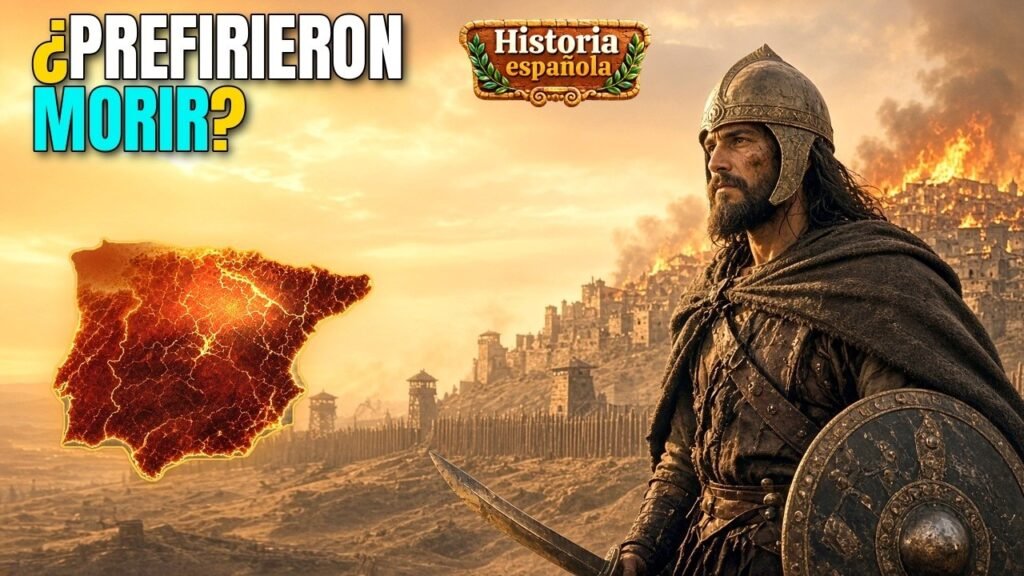
Prefer to watch? The full episode is on YouTube. Subscribe so you don’t miss the next one, and follow us on Facebook.
Quick summary: in the summer of 133 BC, Rome did not take Numantia by storm: it won by digging and waiting. The Numantines were Arevaci, a Celtiberian people — not “Spaniards” in any modern sense. This article follows the war from Segeda (154–153 BC) to Scipio Aemilianus’s siege, and separates what Appian says from the later legend of a mass suicide, reinforced by Cervantes and by the nineteenth and twentieth centuries.
Summer of 133 BC: a city under siege
A Celtiberian city on the Douro has been trapped for months behind a Roman wall almost nine kilometres long. Rome could not take Numantia by assault: it won by digging and waiting. The documentary’s opening question is simple and hard: how did the city hold out for twenty years against the greatest power in the Mediterranean, and what really happened in its last days?
The Arevaci and the hill of La Muela
The Numantines were Arevaci, a Celtiberian people of the Douro valley. The site is identified with the hill of La Muela, near Garray (Soria). They were not a national symbol of a Spain that did not yet exist: they were an Indigenous community fighting for its independence against Rome.
The documentary also reconstructs daily life inside a compact Celtiberian town. That matters, because later myth turned Numantia into a gesture rather than a lived-in city.
Segeda: the spark of the war
The war did not begin at Numantia. The spark was Segeda, in 154–153 BC: a conflict over the extension of a wall and over the obligations Rome had imposed on the Celtiberians. From there came years of campaigns, ambushes and Roman setbacks. The documentary recalls Carus’s ambush on the day of the festival of Vulcan, Nobilior’s elephants and the disaster that followed, and how Viriathus’s war in Lusitania also fed the Numantine front.
Mancinus: a Roman army surrenders
One of Rome’s gravest episodes was not a defeat in open battle, but a surrender. The consul Gaius Hostilius Mancinus was trapped with his army and bargained for a withdrawal. The scandal in Rome was enormous: a Roman army had surrendered to a Celtiberian city. The affair, recorded by the classical sources, helps explain why the Senate eventually sought an extraordinary command.
Scipio Aemilianus and the nine-kilometre wall
That command went to Scipio Aemilianus, the destroyer of Carthage. He tightened discipline, avoided a frontal assault and ringed Numantia with seven camps and a walled circuit with towers. Beams bristling with blades were placed on the Douro so that no one could enter or leave by the river. The aim was not the glory of a fight, but to starve the city into surrender.
The archaeology of the camps — from Adolf Schulten’s excavations (1905–1912) to later work by Morales Hernández, Morillo and others — has made it possible to follow that system on the ground, even if not every detail in the written sources can be traced stone by stone.
Retogenes, Lutia, hunger and surrender
As the siege tightened, Retogenes made a desperate sortie in search of help. The documentary also tells the tragedy of Lutia, the city asked for aid, which paid a terrible price when Rome found out. Inside Numantia, hunger did the work that assaults had failed to do. In the end there was a surrender. What exactly happened in those last days is where history and myth part company.
A mass suicide? What Appian says
The most repeated image is of an entire city choosing death over surrender. Appian, the main source, describes a dreadful end — hunger, despair and deaths — but he does not authorise the simplified version of a total, unanimous suicide. The documentary separates what the text says from the later legend: not everyone died by their own hand, and there were survivors who ended up in Roman hands.
Centuries later, Cervantes wrote The Siege of Numantia, and in the nineteenth and twentieth centuries the episode became a national myth of heroic resistance. That literary and political layer is real as culture; it is not a record of what happened in 133 BC.
Verdict: more human than the myth
What is solid: Numantia resisted Rome for years; Scipio defeated it with a systematic siege, not a lightning assault; the end was brutal, and hunger was the decisive weapon. What is debated: the detail of earlier campaigns, and how exactly to read the figures and gestures in the sources. What is mythical: mass suicide as the only ending, and the idea that the Numantines were already “Spaniards” defending a nation.
The ending is more human than the myth, and therefore more interesting. To see the reconstruction step by step, watch the documentary above. For how Rome first reached the peninsula, continue with the Roman invasion of Hispania in 218 BC.
Frequently asked questions about the siege of Numantia
When was the siege of Numantia?
The city fell in 133 BC, after a siege led by Scipio Aemilianus. The Celtiberian war that explains it begins earlier, with the Segeda conflict in 154–153 BC.
Who were the Numantines?
They were Arevaci, a Celtiberian people of the Douro. They were not Spaniards in the modern sense: that category did not exist in the second century BC.
Did Rome take Numantia by storm?
No. After earlier failures, Scipio surrounded the city with camps and a wall of almost nine kilometres and waited for hunger to force a surrender.
Was there a mass suicide?
Appian describes a terrible end, with hunger and deaths, but the idea of a total suicide of the whole city is a later simplification, reinforced by Cervantes and by nineteenth- and twentieth-century nationalism.
Where is Numantia?
The site is identified with the hill of La Muela, at Garray, near Soria. It can be visited; the regional government maintains information at numanciasoria.es.
📚 Recommended books
Further reading
Numancia. Símbolo e historia


As an Amazon Associate I earn from qualifying purchases.
More Historia española episodes
- Who was Viriathus, and what did he do? The Lusitanian leader who stood up to Rome
- Rome didn’t come to conquer Hispania… and stayed for 600 years
- Gallaeci: were they Celts? Hillforts, Rome and Mount Medullius
- Did Tartessos really exist? What archaeology shows
- History of Hispania: a timeline of the Iberian Peninsula
- All episodes
Prefer to watch? The full episode is on YouTube. Subscribe so you don’t miss the next one, and follow us on Facebook.
Main sources
- Appian, Iberike 44–98; Plutarch, Tiberius Gracchus 5–7 and Marius 3 and 13; Livy, Periochae 47, 56–59; Florus 1.34; Orosius 5.7
- A. Schulten’s excavations at Numantia (1905–1912); F. Morales Hernández and Á. Morillo on Scipio’s camps and Renieblas
- The Numantia site (Junta de Castilla y León): numanciasoria.es
- Historia española documentary “El final más brutal de Numancia que los libros de historia ocultan” (2026)
2 comments