
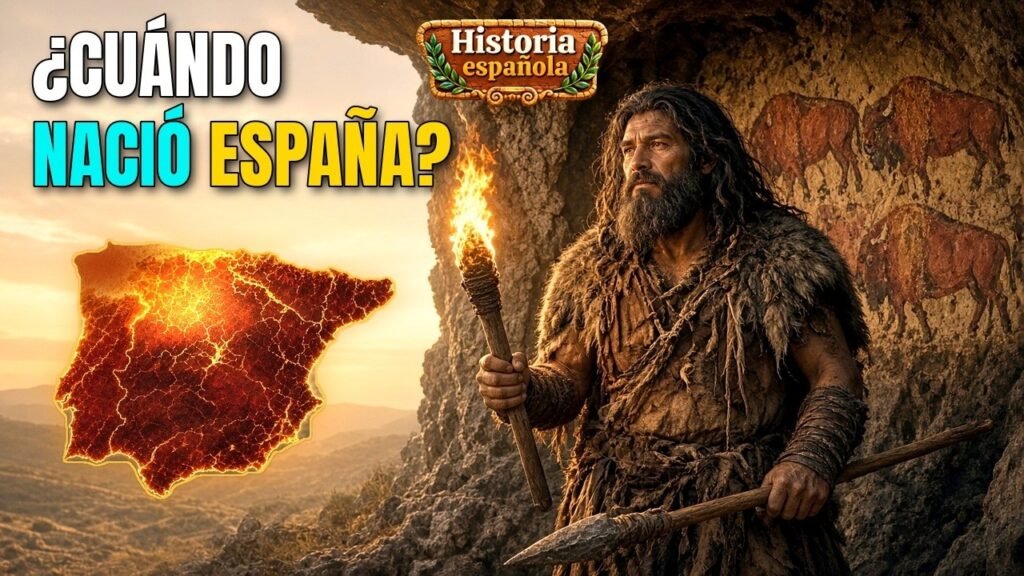
Prefer to watch? The full episode is on YouTube. Subscribe so you don’t miss the next one, and follow us on Facebook.
Quick summary: when does the history of Spain really begin? Not with a king, and not with a battle: the origin of the Iberian Peninsula was written in rock hundreds of millions of years before a single human being existed. This documentary — a new version, telling the same geological story under a different title from the 2026 original, which is now unlisted — follows the Variscan orogeny, Pangaea and the birth of the Atlantic, Africa’s push that raised the Pyrenees and the Baetic ranges, the rivers and glaciers, the caves of Atapuerca, and the metals that later attracted Tartessos, the Phoenicians, Carthage and Rome.
The question almost no one asks
When does the history of Spain begin? The usual answer looks for a king, a battle or a school-book date. The documentary asks another: there was a time when, seen from space, this land could not be recognised. There was no Atlantic, no Mediterranean, no peninsula. The origin was written in rock long before a single human being existed.
The video’s metaphors — a carpet being folded, the Earth “making proposals” — are the authors’. The dates and geological processes are those used in current research.
A map you would not recognise
Continents move, very slowly, at a speed comparable to the growth of fingernails: a few centimetres a year. Over hundreds of millions of years, great land masses joined and split again and again. A granite rock in the Sierra de Gredos, which looks motionless, has in fact travelled enormous distances, carried by that movement. If we went far enough back, we would recognise nothing of what we now call the Iberian Peninsula.
340 million years: the collision that raised giants
Roughly between 340 and 300 million years ago, a chain of continental collisions produced the Variscan — or Hercynian — orogeny. It raised a great mountain range, and the sierras of the centre of the peninsula, now worn and rounded, are what remains of it. Rain, wind and rivers then took those mountains apart, grain by grain. Their remains were laid down, layer upon layer, in ancient seas: the strata that now allow geologists to read the past.
Pangaea and the crack that became an ocean
Future Iberia was joined into the supercontinent Pangaea, attached to lands that are now North America and North Africa, with no ocean in between: in that sense, you could walk to what is now America. Then Pangaea began to break. Cracks opened, water entered, and over millions of years the Atlantic Ocean was born. Every wave that breaks today on the coasts of Galicia or Portugal exists because that crack kept opening.
Africa pushes: the Pyrenees, the Baetics and rocks from the seafloor
Caught between the Eurasian and African plates, the peninsula went on changing. After the extinction of the dinosaurs, about 66 million years ago, Africa pushed hard against Europe and the crust folded, like a carpet shoved at one end. That is how the Pyrenees rose, and the Baetic ranges in the south as well.
That is why there are rocks on the summits that formed on the seafloor: layers born under water that the collision of plates folded and lifted. The bottom of the sea ended up as a mountain top.
The rivers and the ice that carved the summits
Meanwhile rivers such as the Douro, the Tagus, the Ebro and the Guadalquivir were cutting their valleys and choosing — in a geological, not a human, sense — their path through the relief. In the Pleistocene glaciations, glaciers shaped cirques, U-shaped valleys and mountain lakes, without covering the whole peninsula. Ice finished the work that plate collision and river erosion had begun.
Did we choose where to live — or did the land decide?
When the first human groups reached the peninsula, more than a million years ago, the stage was already set. Relief decided where the rivers ran, which passes were practicable, and where there was shelter or metal. The documentary’s question is not rhetorical: part of the human history of Iberia is conditioned by decisions the Earth itself made.
Atapuerca: why there, of all places?
Limestone and water created caves. In the Sierra de Atapuerca, a UNESCO World Heritage Site since 2000, those caves preserved remains that are fundamental for understanding human origins in Europe. The documentary asks why there, of all places: it is no accident that a karst system in the right place kept what would have been lost in the open air. Caves such as Altamira and Nerja, also tied to that geology, later preserved another kind of memory: Palaeolithic art.
The gold of Tartessos and a mountain pass 4,000 years old
The metals — copper, silver, gold, iron — that centuries later attracted Tartessos, the Phoenicians, Carthage and Rome had formed inside the Earth long before. The landscape did not only keep bones in a cave: it also placed underground the wealth that would later kindle trade in the southwest. For what archaeology has found behind the name Tartessos, continue with did Tartessos really exist?.
The documentary gives a chapter to a mountain pass used for some 4,000 years: an example of how relief decided the routes. The details of that pass are in the video; we do not go beyond what the chapter title itself announces.
Where does the history of Spain begin?
The conclusion does not change because the title has changed. The history of Spain did not begin with a king, or with a battle. It began with the Earth itself, which drew the mountains, rivers and coasts that later decided where to live, which way to travel and what to defend. The rest — Tartessos, Rome, Covadonga, the kingdoms — comes afterwards, and already has its place on this site. For a timeline of what followed, continue with the History of Hispania.
Frequently asked questions about when the history of Spain begins
When does the history of Spain begin?
If you look for a kingdom or a battle, the school-book dates come very late. The documentary argues that the stage — mountains, rivers, coasts, caves and metals — was written in rock hundreds of millions of years earlier, and that this geology shaped the human history that followed.
How was the Iberian Peninsula formed?
Over hundreds of millions of years: the Variscan orogeny raised a great mountain range, the break-up of Pangaea opened the Atlantic, and the collision between Africa and Europe raised the Pyrenees and the Baetics. Rivers, glaciers and erosion then shaped the present relief.
What is the Variscan or Hercynian orogeny?
A series of continental collisions, roughly between 340 and 300 million years ago, that raised a great mountain range. The sierras of the centre of the peninsula are its remains, now heavily worn.
Why are there marine rocks in the mountains?
Because many rock layers formed on the floor of ancient seas, and the collision of plates folded and lifted them. The bottom of the sea ended up as a summit.
What does geology have to do with Tartessos or Atapuerca?
Limestone and water formed the caves of Atapuerca, where human remains were preserved. The metals of the southwest, formed far earlier, later attracted Tartessos, the Phoenicians, Carthage and Rome.
📚 Recommended books
Further reading


As an Amazon Associate I earn from qualifying purchases.
More Historia española episodes
- Did Tartessos really exist? What archaeology shows
- History of Hispania: a timeline of the Iberian Peninsula
- Gallaeci: were they Celts? Hillforts, Rome and Mount Medullius
- Roman invasion of Hispania: how Rome arrived in 218 BC
- Covadonga: the miracle that was written 150 years later
- All episodes
Prefer to watch? The full episode is on YouTube. Subscribe so you don’t miss the next one, and follow us on Facebook.
Further reading
- Gibbons, W. and Moreno, T. (eds.), The Geology of Spain, Geological Society of London, 2002
- Pastor-Galán, D. et al., “One or two oroclines in the Variscan orogen of Iberia?”, Geology 43 (2015)
- Muñoz, J. A., “Evolution of a continental collision belt: ECORS-Pyrenees…”, in Thrust Tectonics (1992)
- Renne, P. R. et al., “Time Scales of Critical Events Around the Cretaceous-Paleogene Boundary”, Science 339 (2013)
- Lemartinel, B., “Glacial events in the western Iberian Mountains”, in Quaternary Glaciations (2004)
- Carbonell, E. et al., “The first hominin of Europe”, Nature 452 (2008)
- UNESCO, Archaeological Site of Atapuerca; Cave of Altamira; IGME; Cueva de Nerja
- Historia española documentary “¿Cuándo empieza la historia de España? Mucho antes que cualquier rey” (2026)
1 comment