
Prefer to watch? The full episode is on YouTube. Subscribe so you don’t miss the next one, and follow us on Facebook.
Short answer: the conquest of Mexico-Tenochtitlan was led by Hernán Cortés, who sailed from Cuba in 1519 with about five hundred men, but he did not do it alone or with “a few Spaniards”. The city fell on 13 August 1521, after a siege of almost three months, thanks also to tens of thousands of allied Indigenous warriors, above all Tlaxcalans and Texcocans, and after a smallpox epidemic had struck the city in 1520. And present-day Mexico was not conquered in 1521: the fall of Tenochtitlan was the start of a process that lasted decades.
This article is a summary. The full story of the “few Spaniards” myth is in the documentary above and in the episode article: Did a few Spaniards conquer America? The myth you were told. On how the expedition began, see also Did Hernán Cortés burn his ships? What the sources say.
The question is misleading: it wasn’t “one man” alone
The textbook answer, “Hernán Cortés conquered it”, is not false, but it falls short in two ways. The first is who did the fighting. Cortés led a few hundred Spaniards, who with reinforcements numbered somewhat over nine hundred by the final siege, but the war against the Mexica was fought mostly by Indigenous peoples who were enemies of Tenochtitlan or unwilling subjects of it. The historian Matthew Restall summed this up by calling them “Indian conquistadors”.
The second is what was conquered. In 1521 the capital of the Triple Alliance fell, not a country called Mexico. Decades of campaigns followed in the west, including the Mixtón War of 1540–1542, and in the south-east, where the conquest of Yucatán dragged on for much of the 16th century, and the last independent Maya kingdom, in the Petén of Guatemala, did not fall until 1697.
Cortés and the 1519 expedition
Hernán Cortés was a minor nobleman from Extremadura settled in Cuba. The island’s governor, Diego Velázquez, commissioned him to lead an expedition to the coast of the Gulf of Mexico and then tried to take the command away from him, but Cortés sailed anyway in early 1519. According to Bernal Díaz del Castillo, who went with him, on Cozumel there were five hundred and eight soldiers, not counting masters, pilots and sailors, with sixteen horses and eleven ships.
Along the way he gained two decisive assets: Jerónimo de Aguilar, a Spanish castaway who spoke Maya, and a Nahua woman handed over in Tabasco, Malintzin, whom the Spaniards called Doña Marina, who spoke Nahuatl and Maya. Together they made it possible to talk to Moctezuma’s envoys. On the coast Cortés founded the Villa Rica de la Vera Cruz to break legally with Velázquez and answer only to the king, and he ran his ships aground so nobody could go back to Cuba. He did not burn them: we explain that in the article on the ships.
▶ Watch in the Cortés video 0:53: what he wrote about the ships
Tlaxcala and the other Indigenous alliances
The first alliance was with the Totonacs of Cempoala, who paid tribute to the Mexica. The decisive one came later. Tlaxcala was an independent territory, surrounded by the Triple Alliance and at war with it for generations. In September 1519 it fought the Spaniards hard; after several battles its leaders decided to ally with them. From then on, thousands of Tlaxcalans went with Cortés.
With those allies, Cortés passed through Cholula, where the Spaniards and Tlaxcalans carried out a great massacre, and entered Tenochtitlan on 8 November 1519. Moctezuma received him and was soon held captive. In 1520 everything broke down: Pedro de Alvarado attacked the Mexica during the festival of Toxcatl, Moctezuma died in circumstances that Spanish and Indigenous sources tell in opposite ways, and the Spaniards fled the city with huge losses on the so-called Noche Triste, the “Sad Night”. Tlaxcala took them in when they were at their weakest. Without that decision, the expedition would probably have ended there. Later they were joined by Texcoco, one of the three cities of the Triple Alliance, which split and partly changed sides, by Huexotzinco, Chalco and other peoples of the valley.
The siege and fall of Tenochtitlan (13 August 1521)
When the Spaniards came back, the city had changed. Smallpox, a disease unknown in the Americas, had arrived in 1520, causing great mortality and killing the new tlatoani, Cuitláhuac. He was succeeded by Cuauhtémoc. Cortés then prepared a siege by water and by land: thirteen brigantines were built in Tlaxcala under the carpenter Martín López, carried overland in pieces and launched on Lake Texcoco.
At the muster he held on 28 April 1521, Cortés counted somewhat over nine hundred Spaniards. He himself speaks of more than a hundred and fifty thousand allies, his own figure, which cannot be checked but indicates the proportion. The siege lasted almost three months: the water from Chapultepec was cut off, the fighting went causeway by causeway and house by house, and hunger and disease did the rest. The last resistance was concentrated in Tlatelolco. On 13 August 1521 Cuauhtémoc was captured in a canoe and the city fell. The Nahua accounts gathered by Miguel León-Portilla in Visión de los vencidos (in English, The Broken Spears) tell those days from the inside.
Why the idea of “a few Spaniards” lives on
Partly because of the sources. The Letters Cortés wrote to the emperor put him at the centre and leave the allies in the background; the biography published by Francisco López de Gómara in 1552 made him a hero; and in the 19th century William H. Prescott’s great history fixed for the public the image of a handful of adventurers against an empire. The logic of heroic storytelling, on both sides of the Atlantic, which needs individual protagonists, also helped.
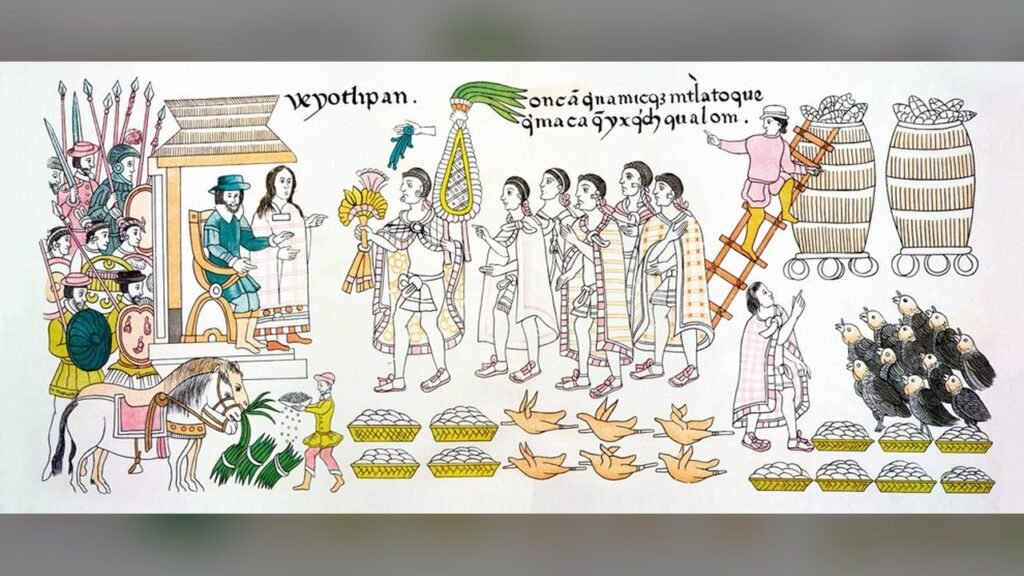
None of this diminishes the Spaniards’ importance. Their steel, their horses, their boats on the lake and Cortés’s political skill in exploiting the divisions of the Mexica world were decisive. What research in recent decades, from Hugh Thomas to Restall, has made clear is that it was a war in which most of the combatants were Indigenous, and many of them fought for their own goals. The Tlaxcalans knew this well, and later recalled it in the Lienzo de Tlaxcala to claim their privileges. If you are interested in how all this was told in Europe, continue with the Black Legend and Bartolomé de las Casas.
Frequently asked questions about who conquered Mexico
Who conquered Mexico, and in what year?
Hernán Cortés led the conquest of Tenochtitlan, the Mexica capital, which fell on 13 August 1521, with decisive help from Indigenous allies. The conquest of the rest of present-day Mexico went on for decades.
How many Spaniards conquered Mexico?
Cortés set out with about five hundred men in 1519, according to Bernal Díaz. For the 1521 siege he counted somewhat over nine hundred, alongside tens of thousands of allied Indigenous warriors.
Who helped Cortés?
Above all Tlaxcala, and also the Totonacs of Cempoala, part of Texcoco, Huexotzinco, Chalco and other peoples of the Valley of Mexico who were enemies of the Mexica or resented their rule.
What happened to Moctezuma and Cuauhtémoc?
Moctezuma died in 1520 while held by the Spaniards; the sources disagree about who killed him. Cuauhtémoc, the last tlatoani, was captured in 1521 and executed on Cortés’s orders in 1525, during the expedition to Honduras (the Hibueras).
📚 Recommended books
Further reading


As an Amazon Associate I earn from qualifying purchases.
More Historia española episodes
- Did a few Spaniards conquer America? The myth you were told
- Did Hernán Cortés burn his ships? What the sources say
- The Black Legend: did Bartolomé de las Casas exaggerate?
- All episodes
Prefer to watch? The full episode is on YouTube. Subscribe so you don’t miss the next one, and follow us on Facebook.
Main sources
- Hernán Cortés, Cartas de relación (Letters from Mexico), 2nd and 3rd letters (1520 and 1522)
- Bernal Díaz del Castillo, Historia verdadera de la conquista de la Nueva España
- Bernardino de Sahagún, Florentine Codex, book XII; M. León-Portilla, Visión de los vencidos (1959; Eng. The Broken Spears)
- H. Thomas, Conquest: Montezuma, Cortés and the Fall of Old Mexico (1993)
- M. Restall, Seven Myths of the Spanish Conquest (2003)
- Historia española documentaries “¿Conquistaron América unos pocos españoles?” and “Hernán Cortés y las naves” (2026)
- Featured image: anonymous Tlaxcalan artist (16th century), public domain, via Wikimedia Commons