
Prefer to watch? The full episode is on YouTube. Subscribe so you don’t miss the next one, and follow us on Facebook.
Quick summary: “burning your ships” is one of the most famous images in the history of Spain. But in his second letter to Emperor Charles V, dated 30 October 1520, Hernán Cortés does not mention fire: he writes that, on the pretext that the ships were unseaworthy, he ran them ashore. Bernal Díaz, who was there, speaks of beaching them. Gómara, who was not, speaks of scuttling them. The fire appears later, in eulogies and in literature.
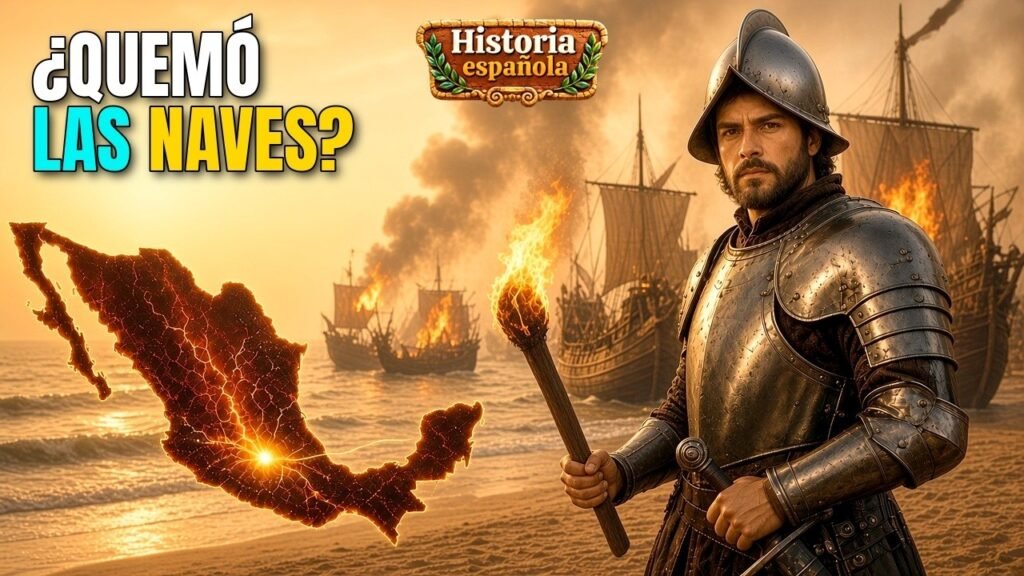
What if Cortés never burned his ships?
Veracruz, 1519. The picture is famous: Cortés sets fire to his ships so that no one can turn back. It became a set phrase. The documentary tests that scene against the sources, and ends by recommending a book for getting to know Cortés beyond the legend.
What Cortés wrote: “I ran them ashore”
The earliest source is the second carta de relación, written more than a year after the events and intended for the king. Cortés says that some men, friends and servants of Diego Velázquez, the governor of Cuba, planned to take a brigantine back to the island to warn him. He says he punished them “according to justice”, and that others, seeing how large the land was and how few the Spaniards were, also wanted to leave.
Then comes the key sentence: he found a way, “socolor” — on the pretext — that the ships were unseaworthy, to run them ashore, “so that everyone lost hope of leaving the land”. Two details matter. Cortés himself admits he used a pretext. And he speaks of beaching the ships, not of burning them. It also matters who is writing: he had left Cuba at odds with Velázquez and needed to justify himself before the emperor.
The witness: Bernal Díaz and a decision “of everyone”
Bernal Díaz del Castillo, a soldier of Cortés, wrote his True History of the Conquest of New Spain decades later. He too recalls the plot: several men planned to flee to Cuba, and one of them warned Cortés. There were death sentences. Then comes the episode of the ships. Bernal says that he and other friends advised Cortés not to leave a single ship in port, but to “dar al través” with them all: to run them aground and render them useless.
He adds something decisive: in his view, Cortés already had it planned, but wanted the idea to “come from us”, in case anyone later claimed the value of the ships. He ordered Juan de Escalante to remove anchors, cables, sails and everything usable, and to beach the hulls. Sailors who could fight became soldiers. Bernal does not mention fire either, and presents the decision as something agreed, not a solitary gesture.
Gómara: scuttled in secret, or in plain sight?
In 1552 Francisco López de Gómara, Cortés’s chaplain, published his history of the conquest. He had not been in Mexico. According to him, Cortés agreed to break up the ships and arranged with some masters to scuttle them in secret — to bore holes in them — while other pilots said they were eaten by shipworm.
This angered Bernal. He corrects Gómara several times and insists it was not done in secret, but in plain sight. Already in the sixteenth century, then, the testimonies disagree about the method. What the three versions do agree on is something else: none of them mentions fire.
Where does the fire come from?
The clue is not in an eyewitness chronicle, but in a eulogy. According to the hispanist Winston Reynolds and the historian Hugh Thomas, one of the earliest known mentions of a burning appears in 1546, in a letter the humanist Francisco Cervantes de Salazar dedicated to Cortés at the front of his Obras, printed in Alcalá. The text praises Cortés for removing any chance of regret or hope of return.
In the digital edition consulted in the video, the phrase “mandó fuego los navíos” appears, but the words in brackets are a modern editor’s reconstruction, not a reading that can be attributed without reserve to the 1546 printing. In the Madrid reprint of 1772 the phrase reads “then burning the ships”. The documentary could not consult the 1546 original, so it treats that reading with caution. Thomas also suggests the legend may have been born from a confusion between “quebrando” (breaking) and “quemando” (burning). That is a hypothesis, not a proven fact.
Cervantes de Salazar compares Cortés to Alexander and Julius Caesar. Reynolds argues that the fire legend grew from that habit of comparing him to ancient heroes — such as Agathocles of Syracuse or the emperor Julian — who were said to have burned their ships. On that reading, the fire does not come from the witnesses: it comes from the eulogies, and became legendary later in literature.
Is there anything under the water?
A 2021 article in The SAA Archaeological Record reports that an INAH underwater archaeology team has found period anchors off the Veracruz coast, one of them with wood dated to between the late fifteenth and early sixteenth centuries. The authors suggest they could belong to Cortés’s fleet, but this remains an open line of research. It has not been shown that they are his ships.
A book for getting to know Cortés
The documentary recommends, as further reading — not as a source for the video itself — José Luis Martínez’s Hernán Cortés, in the abridged edition published by Fondo de Cultura Económica in 1992 (Breviarios 519; ISBN 978-968-16-4699-8). According to the publisher, the book avoids imaginative flights and, in disputed episodes, sets out Spanish, Indigenous and mestizo versions so that the reader can judge.
Verdict: did Cortés burn the ships?
On the sources closest to the events, no. Cortés says he ran them ashore. Bernal, who was there, says they were beached. Gómara, who was not, speaks of scuttling them. None mentions fire. What is documented is the underlying idea: Cortés disabled his fleet so that no one could return to Cuba, at a moment of tension with men prepared to abandon him.
It is not clear whether it was his decision alone, as he tells it, or an agreement with his captains, as Bernal says. Each had reasons to tell it his own way. The fire arrived later, in eulogies and literature. That may be why it has lasted: because it makes a better story than the truth. For the wider conquest of Mexico, continue with the myth that a few Spaniards conquered America.
Frequently asked questions about Cortés and the ships
Did Hernán Cortés burn his ships?
In the testimonies closest to 1519 there is no evidence that he burned them. Cortés writes that he ran them ashore; Bernal Díaz speaks of beaching them; Gómara, of scuttling them. Fire appears later, in eulogies and literature.
What does “burning your ships” mean?
Today it is a set phrase: cutting off any chance of turning back. Its fame is tied to Cortés at Veracruz, but that image does not match what he or his soldier Bernal Díaz wrote.
Why did Cortés disable his fleet?
There was tension with supporters of Diego Velázquez, governor of Cuba, and a risk that someone would return to the island to denounce him. Disabling the ships closed that door. Cortés presents it as his decision; Bernal, as something agreed.
Have the ships been found?
Period anchors have been found off Veracruz, and there is a working hypothesis that they could be related to the fleet, but that has not been proved.
📚 Recommended books
Further reading


As an Amazon Associate I earn from qualifying purchases.
More Historia española episodes
- Who conquered Mexico? Cortés, the Indigenous alliances and the fall of Tenochtitlan (1521)
- Did a few Spaniards conquer America? The myth you were told
- The Black Legend: did Bartolomé de las Casas exaggerate?
- All episodes
Prefer to watch? The full episode is on YouTube. Subscribe so you don’t miss the next one, and follow us on Facebook.
Main sources
- H. Cortés, Cartas y relaciones, ed. P. de Gayangos (Paris, 1866), second letter
- B. Díaz del Castillo, Historia verdadera (Madrid, 1862), vol. I
- F. López de Gómara, Historia de las Indias y conquista de México (1552), ch. XLII
- F. Cervantes de Salazar, epistle to Hernando Cortés (Obras, Alcalá, 1546); Madrid reprint, 1772
- W. A. Reynolds, “Hernán Cortés y los héroes de la antigüedad”, Revista de Filología Española (1962)
- D. M. Carballo, K. Alcantara and A. López Corral, The SAA Archaeological Record (2021)
- H. Thomas, The Conquest of Mexico (1993)
- Historia española documentary “Hernán Cortés y las naves: ¿de verdad las quemó?” (2026)