
Prefer to watch? The full episode is on YouTube. Subscribe so you don’t miss the next one, and follow us on Facebook.
Short answer: the Spanish Black Legend is the name given to a negative and persistent image of Spain and the Spanish, as a cruel, fanatical, greedy and backward people, which spread across Europe from the 16th century, largely through the propaganda of the Spanish monarchy’s rivals. The term was popularised by Julián Juderías in 1914, although Emilia Pardo Bazán had already used it in 1899. Historians agree that the propaganda existed; what they debate is how much weight it had, how it differed from what was said about other empires, and whether the concept helps us understand the past or, at times, defend it.
This article is a summary. Here we explain the term and the debate. The question of whether Bartolomé de las Casas exaggerated is covered in depth in the documentary above and in the episode article: The Black Legend: did Bartolomé de las Casas exaggerate?
Where the term “Black Legend” comes from
The expression is not from the 16th century but from the turn of the 20th. Emilia Pardo Bazán spoke of a “black legend” about Spain in a lecture in Paris in 1899, a year after Spain’s defeat by the United States. The person who turned it into a concept was Julián Juderías, a Madrid-born historian, journalist and translator, with his book La leyenda negra y la verdad histórica (The Black Legend and Historical Truth), published in 1914.
Juderías defined it, in essence, as the climate created by fanciful accounts of Spain published in other countries, which exaggerated the Inquisition, intolerance and Spanish cruelty, and ignored or denied Spain’s contributions to culture and science. His book was born in a moment of national crisis and had a defensive, patriotic purpose. That does not invalidate it, but it helps to read it properly: it is both a pioneering study and a polemical work.
What that image of Spain is made of
The Black Legend is not a single book but a set of themes that accumulated over the centuries. The most repeated are the Inquisition, presented as the cruellest tribunal in Europe; Philip II as a gloomy tyrant; the cruelty of Spanish soldiers in Italy and Flanders; the destruction of the peoples of the Americas; and, later, the idea of a backward Spain, closed to science and liberty.
Some of those themes rested on real events, such as the sack of Antwerp in 1576 or the abuses of the conquest. Others were exaggerations or inventions, like the legend of Prince Don Carlos murdered by his father, which passed into literature and opera. The Swedish historian Sverker Arnoldsson argued that the first anti-Spanish stereotypes were born in 15th- and 16th-century Italy, before the great wave of Protestant propaganda.
The role of Las Casas and his Brevísima relación
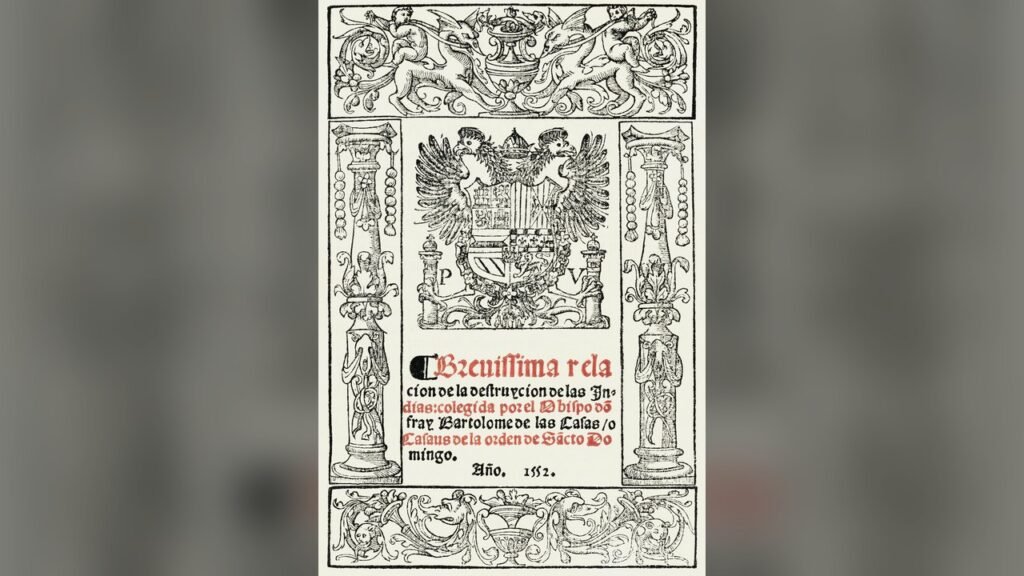
No text has weighed so heavily on that image as the Brevísima relación de la destrucción de las Indias (A Short Account of the Destruction of the Indies), which the Dominican friar Bartolomé de las Casas published in Seville in 1552. Las Casas was not writing against Spain but to get the Crown to curb the abuses of conquistadors and encomenderos. His denunciation was part of a lively internal debate: the New Laws of 1542 and the Valladolid debate of 1550–1551 questioned the legitimacy of the conquest at court itself.
The problem came later. The Brevísima was translated into Dutch in 1578, French in 1579 and English in 1583, and in 1598 it appeared in Latin in Frankfurt with Theodor de Bry’s engravings, which turned it into a visual weapon. A text written to reform the empire from within served its enemies to attack it from outside. Whether he exaggerated, and in what, we explain in the episode article.
The propaganda of rival powers in the 16th and 17th centuries
The Spain of Charles V and Philip II was the greatest power in Europe, and its rivals attacked it with the printing press too. During the Dutch Revolt, William of Orange’s Apology (1581) portrayed Philip II as a tyrant. In 1567 a book attributed to “Reginaldus Gonsalvius Montanus” had been published in Heidelberg describing the methods of the Spanish Inquisition, and it circulated across Protestant Europe. The Relaciones of Antonio Pérez, Philip II’s fugitive secretary, fed the image of the gloomy king from France and England.
Two things are worth remembering. First, propaganda was everyone’s weapon: the Spanish monarchy also used it against its enemies, and other powers such as England and France received their own negative images. Second, the image lived on long afterwards. In 1782 the article “Spain” in the Encyclopédie méthodique, by Nicolas Masson de Morvilliers, asked what Europe owed to Spain, and in 1898 the American press revived the old clichés during the war over Cuba.
What historians say today
There is broad agreement on two points: that there was very intense anti-Spanish propaganda, and that this does not erase the real abuses of the conquest or the Inquisition, many of them denounced by Spaniards themselves. Beyond that, positions vary. Historians such as the American Philip Wayne Powell, in Tree of Hate, stressed the strength and persistence of Hispanophobia. Others warned of the risk of falling into a “white legend” that justifies everything.
Ricardo García Cárcel, in La leyenda negra. Historia y opinión (1992), rejected the idea of a deliberate conspiracy against Spain and stressed the weight of Spanish self-criticism in the origins of that image. In 2016, Elvira Roca Barea reopened the debate with Imperiofobia y leyenda negra, which presents it as a phenomenon common to all empires and became a bestseller. José Luis Villacañas responded in 2019 with Imperiofilia y el populismo nacional-católico, a sharp critique of her theses. The debate remains open, and it is also a debate about the present.
To see how these layers mix in a specific case, continue with the myth that a few Spaniards conquered America or with the story of Cortés’s ships.
Frequently asked questions about the Spanish Black Legend
Who coined the term “Black Legend”?
Emilia Pardo Bazán used it in 1899, but the person who popularised it and turned it into a concept was Julián Juderías, with his 1914 book La leyenda negra y la verdad histórica.
Is the Black Legend true?
It is a mixture. It rested on real events, such as the violence of the conquest or the Inquisition, but it exaggerated them, took them out of context and presented them as traits peculiar to the Spanish, which does not stand up to comparison with other empires of the time.
What does Bartolomé de las Casas have to do with the Black Legend?
His 1552 Brevísima relación, written to get the Crown to curb abuses, was translated and used by Spain’s enemies as proof of its cruelty. He did not write it with that intention.
What is “imperiophobia”?
It is the concept Elvira Roca Barea uses for the prejudice that, in her view, all great empires suffer, from Rome to the United States. Her thesis has both defenders and critics, such as José Luis Villacañas.
📚 Recommended books
Further reading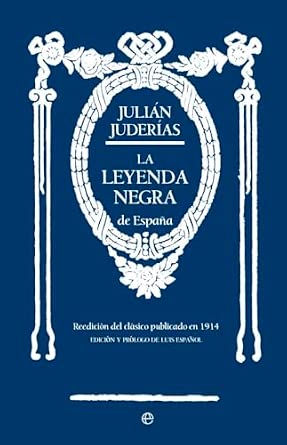


As an Amazon Associate I earn from qualifying purchases.
More Historia española episodes
- The Black Legend: did Bartolomé de las Casas exaggerate?
- Did a few Spaniards conquer America? The myth you were told
- Did Hernán Cortés burn his ships? What the sources say
- All episodes
Prefer to watch? The full episode is on YouTube. Subscribe so you don’t miss the next one, and follow us on Facebook.
Main sources
- B. de las Casas, Brevísima relación de la destrucción de las Indias (Seville, 1552) and its translations of 1578, 1579, 1583 and 1598
- E. Pardo Bazán, Paris lecture (1899); J. Juderías, La leyenda negra y la verdad histórica (1914)
- S. Arnoldsson, La leyenda negra. Estudios sobre sus orígenes (1960)
- P. W. Powell, Tree of Hate (1971)
- R. García Cárcel, La leyenda negra. Historia y opinión (Alianza, 1992)
- E. Roca Barea, Imperiofobia y leyenda negra (Siruela, 2016); J. L. Villacañas, Imperiofilia y el populismo nacional-católico (Lengua de Trapo, 2019)
- Historia española documentary “Leyenda negra: ¿exageró Bartolomé de las Casas?” (2026)
- Featured image: 1552 title page, John Carter Brown Library, public domain, via Wikimedia Commons